Let food be your medicine and medicine be your food.
Hippocrates
As long as there are slaughterhouses there will be battlefields.
Leo Tolstoy
Never doubt that a small group of thoughtful, committed, citizens can change the world. Indeed, it is the only thing that ever has.
Margaret Mead
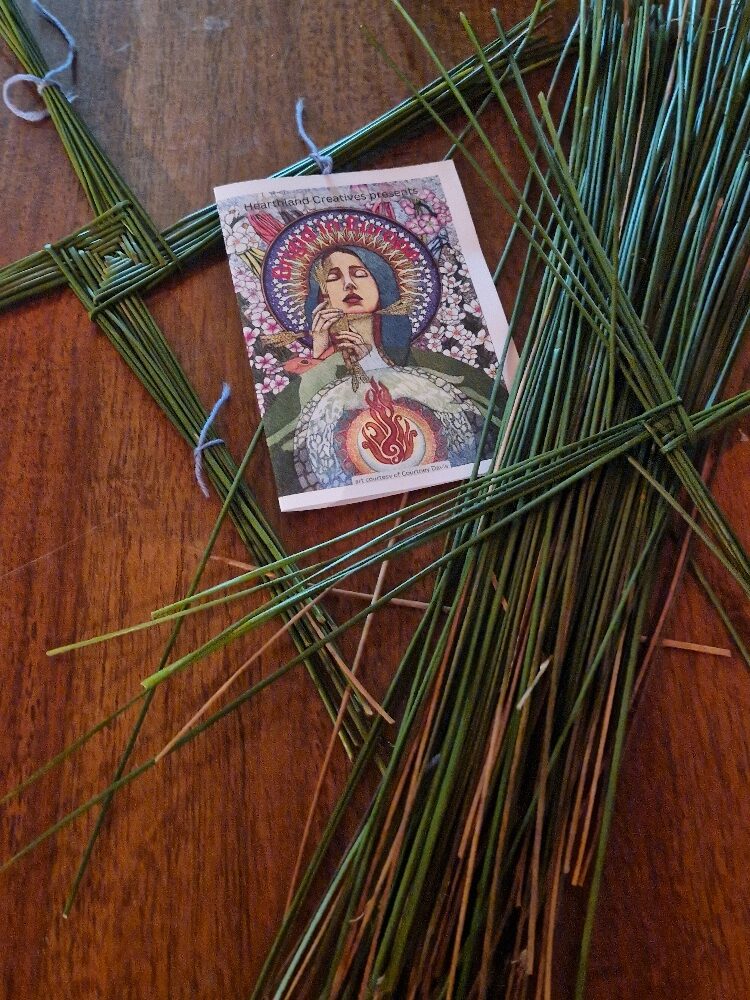
I recently had the unexpected opportunity to participate in a celebration marking the 1,500th anniversary of the birth of an iconic Irishwoman, the mystic, St. Bridget of Kildare. It was a small international gathering of artists, academics, and adherents of Celtic spirituality which met at a location named after this saint in Co. Mayo, in the West of Ireland.
Along with local participants, there were people there who had travelled from Scotland, Germany, Italy, and all four corners of Ireland. Over two days we enjoyed entertaining conversation, interesting presentations, poetry, music, craic, and the best of Irish hospitality.
Unfortunately, the event coincided with an awful spell of weather. This forced us to abandon the original plan to celebrate out of doors at the Kilbride Cemetery three miles outside the small town of Newport, instead moving the main part of the activities to the conference centre of the hotel where we had gathered. This did not dampen our spirits, however, and we did subsequently manage to go to the cemetery to plant a memorial crab-apple tree, – one visitor from Scotland playing Amazing Grace on the pipes in the gale force wind as we did so, – before we all went our separate ways.
Such gatherings are an opportunity to get to know and share ideas with like-minded people. We celebrated Bridget and explored how we could bring her spirit into our daily activities as we meet the challenges of the twenty first century. In my view that spirit includes compassion for our fellows and all living things, and an attitude of gratitude for the wonders of Creation. For me, Bridget ranks among a pantheon of role models which includes figures such as Francis of Assisi, Hildegard von Bingen, Albert Einstein, and Vananda Shiva.
One of the issues that was addressed during the celebrations was how the current very real threat to biodiversity could be countered by planting native woodland. This is a topic dear to my own heart since planting the first native hedges in one of my gardens in Germany over thirty years ago. This was one of several organic gardens I created over the years in which delicious food grew in copious quantities, providing us with much healthy nutrition and many hours and days of communal enjoyment.
I was impressed by the talk given by a local amateur forester and environmentalist. Now in his sixties, he told us about the hectare of native oak he had planted twenty-five years ago. It had meanwhile matured into an enchanting woodland, filled with the sounds and colours of a wide variety of wildlife, birds, and insects. He shared how he enjoys visiting regularly with his family, especially his grandchildren, and his circle of friends, and visiting guests. This sounded great; I made a mental note of going there on my next trip to this locality.
Over night, my mind processed the wide variety of impressions that had come my way over this two-day gathering. I began to wonder if we were not seeing the wood for the trees in some respects. These are the reflection that subsequently came my way.
While planting native forest is both noble and important, not everyone is able to do so. The state, as a major landowner in Ireland, should be encouraged to take the lead here, with additional incentives offered to private landowners to join forces in the initiative. Thankfully, this seems to be the case now, though with less than 2% of land now occupied by native woodland, the project is starting from a very tiny base, and still has a long way to go. Optimists believe that a proportion closer to 30% forest cover could ultimately be achieved, as in some of the leading European countries, and much of this, in the case of Ireland, could be native.
In a side conversation late in the evening I recalled the typical experience thirty years ago whenever we drove a hundred miles on a summer’s evening. The next day we would have to remove from the windscreen the accumulation of insects that had met their doom on colliding with our vehicle. This is no longer the case, not because the insects have adapted to our driving patterns, but because there are simply no longer nearly as many insects alive today. This is only one sharp visible indication of the dramatic fall in biodiversity over this relatively short period of time. This should be a cause of great concern to us all. What is behind this, I wondered?
One hundred years ago, our food came from what we called `farming´, a communal, manual-intensive activity which delivered locally produced harvests using seeds passed down from season to season, from one generation to the next. Availability of produce was determined by the seasonal cycle. For the most part, we had enough good food, knew how to cook and store it, and consumers were prepared to spend, on average, a relatively high proportion of total available income to purchase it.
While wisdom had accrued on how to protect crops using natural methods, the concept of applying synthetic toxins in the process of growing food had not yet emerged. It was a niche which began to be exploited by the chemical industry as soon as the markets of World War II abruptly began to fall away. It was at this point that the focal point of food was moved from the soil and the kitchen to the laboratory.
Today’s food comes from what could be termed the Agri-Industrial Complex (AIC). Yes, there are still local small farmers involved, though, in the consolidation which has occurred in our lifetime, their numbers have decreased dramatically. Average farm size has increased, and the business had become global, promising to deliver whatever we want, whenever we want it, at prices which, relatively speaking, would have been considered illusionary in times past. The clever marketing of the AIC generates demand for the latest innovations of food and keeps the enormous environmental price tag largely hidden from view.
The downside of these developments is a series of destructive practices. Animals are kept all their lives in the most appalling conditions, with hundreds of millions going to the slaughterhouse each and every day. As Paul McCartney once pointed out: If slaughterhouses had glass walls, everyone would be a vegetarian.
Crazy supply chains have emerged. Native forest is cleared in the tropics to make space to grow soja and other crops, which, often shipped overseas, are then used as fodder for cattle, which never get to spend a day in the open, in order to keep the demand for meat consumption satisfied.
In Europe, milk is produced in The Netherlands using fodder which has been grown in Brazil. It is then moved by road from The Netherlands to Italy to produce yogurt, which then goes to Bulgaria to be flavoured and packaged. It is then re-transported throughout the continent, every step in the process being subsidised by the central administration of the European Union, using tax-payers hard-earned money.
Seed management has been consolidated such that a vast majority of local strains are disappearing, replaced by so-called F1-Hybrids or, even worse, GMO (God, move over!) strains which have been designed to withstand the toxic fungicides and insecticides, sold in a diabolical double pack with patented seeds by global corporations such as Monsanto (now Bayer). In 2020, the top four corporations, Bayer (formerly Monsanto), Corteva (formerly DuPont), Syngenta (part of ChemChina), and Limagrain together controlled 50% of the global seed market. From a food security perspective, this is unacceptable.
It is the globalised Agro-Industrial Complex which is one of the main threats to biodiversity. And this is where the topic of leverage comes in.
As hotels go, the one chosen to host our St Bridget Festival was very good. The entire staff was friendly, the rooms comfortable, and the facilities good. The food we ate, however, was undoubtably the produce of the Agri-Industrial Complex. If it had been otherwise, I’m sure this would have been pointed out. For the main part it was heavily tilted towards meat, poultry, and fish, and most of the offerings on the menu contained ingredients from the global supply chain of animal farming (meat, dairy, etc.).
How do I know this? As someone who adopted a vegan diet over a decade ago, I asked for alternatives to the standard menu. Luckily, the young waitress exclaimed that she too maintained a vegan diet and would have a word with the kitchen staff. As a result, I was served tasty, simple, nutritious fare over the two days.
In my role as commercial director of a psychosomatic clinic near Berlin some years ago, I gained insights into the challenge of feeding up to one hundred patients and staff three meals per day. The price difference between locally sourced organic food and the globalised market was extreme, indeed prohibitive within the context of the business model, not to mention the challenge of securing sufficient supplies.
When gardening so enthusiastically all those years ago, I asked myself if I would voluntarily provide financial support to other food producers who were using toxic chemicals in their processes. The answer was a clear no. Since then, I have done my best to consume food grown organically, whenever possible. It is often inconvenient and sometimes more expensive, but that is how it is. For me, it is worth the effort. It is not always possible, especially when I am traveling, and that’s fine too.
Here is the point. We all need to eat. The combined purchasing power of a family is substantial; for any nation it is colossal. The business model of the Agri-Industrial Complex relies on having enough customers to support it. If, say, 10% decided to shift to buying only organically grown food, and another similar percentage went one step further and switched to a vegan diet, the current model would come crashing down. Change would become imperative for all involved.
That was the powerful lesson I took from this weekend. We have this leverage. It is simply a matter of awareness and the willingness to act on this awareness. This is fully in line with the example of role models such as Bridget who led by the power of example.
As the environmental activist and food sovereignty advocate, Vananda Shiva succinctly states: Globalized industrialized food is not cheap: it is too costly for the Earth, for the farmers, for our health. The Earth can no longer carry the burden of groundwater mining, pesticide pollution, disappearance of species and destabilization of the climate. Farmers can no longer carry the burden of debt, which is inevitable in industrial farming with its high costs of production. It is incapable of producing safe, culturally appropriate, tasty, quality food. And it is incapable of producing enough food for all because it is wasteful of land, water, and energy. Industrial agriculture uses ten times more energy than it produces. It is thus ten times less efficient.