Despite having lived in Continental Europe for decades, my inner clock still marks time as I first encountered the concept in my Irish childhood. While, in early adulthood, the hard Bavarian winters often froze our garden pond from early December through to late March, my soul would begin to yearn for the first flashes of colour even before January came to an end. The snowdrops, crocuses and narcissi spring up before my mind’s eye, causing a palpable perception of temporal misalignment between the inner and outer worlds.
Now, living in the milder Rheinland, the chronology is similarly mismatched; only the snow and frost that brightened the long winters down south is lacking. The rare colours currently to be seen come from the leftover berries and rose hips of last year’s crop.
In my native Ireland, February 1st marks the First Day of Spring and the beginning of the farmer’s year. Long before the blooming of the buds, we glimpse the colourful splashes of crocuses and the humble heads of little snowdrops in the still cold earth. This is the time we prepare for a new future that we know is surely coming.
We call the festival `Imbolc´, coming from the Irish `i mbolc´ or `in the belly´ (womb). This may refer to to the pregnancy of ewes or simply to the impending birth of the new cycle. The etymology of Imbolc/Imbolg is not entirely clear. Apart from the explanation above, another possible origin is the Old Irish imb-fholc, `to wash/cleanse oneself´, referring to a ritual cleansing.
Imbolc is the festival of divination, a time for letting go of the old, visiting holy wells, preparation for the new and the infamous spring cleaning. This festival marks the halfway point between the winter solstice and the spring equinox.
Dawn edging noticeably earlier and the stretch in the evenings both show that the days are indeed growing longer. The Goddess of the land is waking up after her deep sleep. She takes the form of a young child – an Brídeog – the child Saint Brigid – filled with new life and promise. Brigid is perhaps the only saint I know who was co-opted from pagan times. In our culture, she is the matriarch, at least as important at Patrick („the holder of male energies“) who, according to legend, arrived in Ireland shortly before her birth.
Brigid’s friendship with Saint Patrick is noted in the following paragraph from the Book of Armagh: „inter sanctum Patricium Brigitanque Hibernesium columpnas amicitia caritatis inerat tanta, ut unum cor consiliumque haberent unum. Christus per illum illamque virtutes multas peregit“ (Between St. Patrick and St. Brigid, the pillars of the Irish people, there was so great a friendship of charity that they had but one heart and one mind. Through him and through her, Christ performed many great works.) This is a reminder that the Christ energies transcend gender.
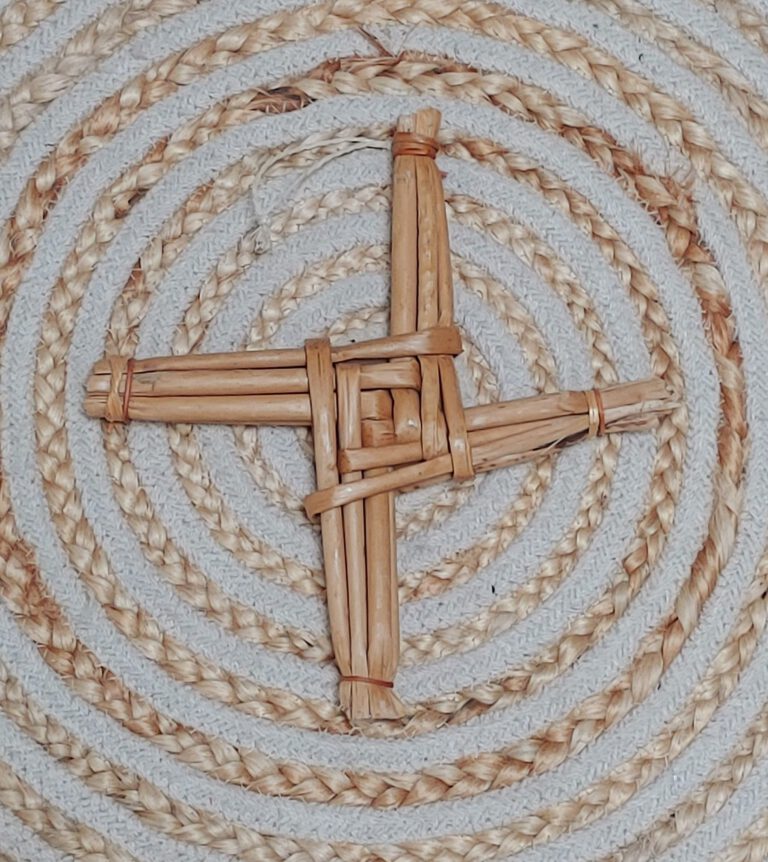
Though women have been relentlessly relegated in the Christian culture over time, Brigid’s standing in Ireland remains at least on a par with Patrick’s. She is the patron saint of many activities; healing, fertility, blacksmiths and poets (these latter two representing the expression of creative imagining), among them. St. Brigid’s Cross is one of the most prominent symbols in Celtic iconography. This symbol is deeply ingrained in the imagination of every Irish child. Brigid, according to folklore, came from a wealthy family and decided to spend her life in the service of the sick and the poor. Legend goes that, while nursing a poor patient at home over a lengthy period, she began to work contemplatively with the straw which was spread on the floor of the humble abode. The result was the cross we all know and which is still to be found in many Irish homes today. For me, it is the symbol of the new beginning.
The new beginnings of Imbolc can be times of tough teachings, requiring us to learn hard and fast lessons. Like the unpredictable weather in these northern climes at this time of year, things can change very suddenly and dramatically. A grey, wet, windy morning can quickly give way to a beautiful, fresh sunny afternoon. A week of mild nights may be followed by one of severe frost or, on occasion, snow.
But as with every season, we can remind ourselves that we do not walk the path alone. Though the circumstances now, in the year 2021, are indeed remarkably challenging, we are not facing the challenges and opportunities of spring for the first time. We can learn from those with more wisdom than ourselves.
So much of that wisdom is passed down to us, encoded in the ancient traditions and customs of the past. It is also encoded in our cells. If we take the time to go within, in silence, we will be given the intuition as to how to best celebrate this festival and navigate the period ahead.
Imbolc has traditionally been celebrated on February 1st. However, because the Celtic day was deemed to begin and end at sunset, the celebrations would start on what is now January 31st (this year, on Sunday night). It has also been argued that the timing of the festival was originally more fluid and based on seasonal changes. It has been associated with the onset of the lambing season (which could vary by as much as two weeks either side of February 1st), the beginning of the spring sowing, and the blooming of blackthorn.
The feast of Saint Blaise – Candlemas, or Maria Lichtmeß (German) – immediately follows Imbolc on February 2nd. In this tradition we will bless our throats (in the Hindu culture, the seat of the sixth Chakra – Vishuddhi, – sky blue) with flame to embolden us to be strong in our voice and clear in our communication. The clarity of our voice in our inner dialogue (between self and Self) is the prerequisite of our ability to express our Self effectively in the world. Now is the time to prepare our own metaphorical horticultural year, to begin to cultivate the garden of our hearts and minds in and for this new cycle.
How can we work the land of our lives to be ready for the seeds of the inner harvest yet to come?