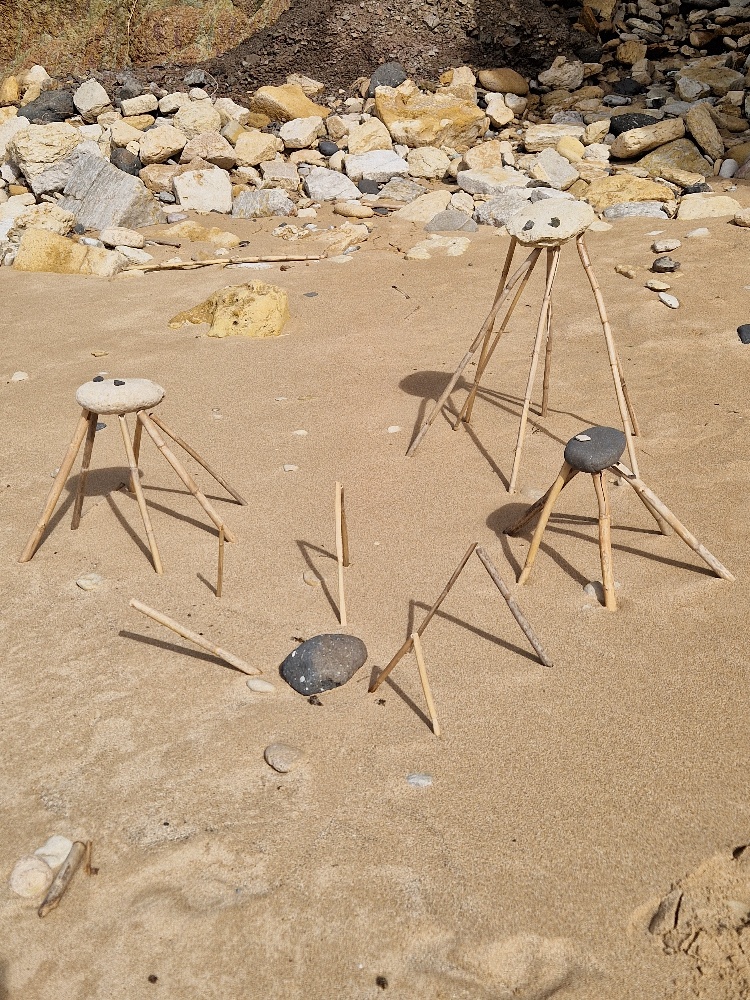
Leading a handful of monks, St Coleman set out from Lindisfarne in the north-east of England. Sea-searched no doubt, wind-searched, and salt-searched, they rowed themselves south along this Atlantic coast.
Following the old Christian custom, it is likely that they would at one stage have shipped oars, and then wherever the currents took them, that’s where they would settle.
To ship oars. To surrender to something bigger and wiser than we are. I thought about it. The shark is a free swimmer. He has the muscles and the endowments that enable him to go where he chooses. As their Greek name tells us, plankton are drifters, they go with the ocean currents. How extraordinary, I thought, that those early Christian monks were so willing to be plankton.
John Moriarty – Nostos
The attitude of faith is to let go, and become open to truth, whatever it might turn out to be.
Alan Watts
A miracle is a shift from fear to love.
Marianne Williamson, A Course In Miracles Commentary
„To ship oars.“ That phrase was new to me up to a few weeks ago. It has never been far from my deeper musings since. So today I will explore the resonance, do a deeper dive into what sparks appear to be illuminating the firmament of my imagination.
Like many of you, I was taught to get a grip on life from an early age. The prevailing view was that we could achieve a „good“ life through discipline and effort. Importance was also placed on other factors such as selflessness, honesty, and the love of our neighbour.
The prevailing old-testament variant of the Irish Catholic ethos of the sixties and seventies could be boiled down to the fear-driven mantra: „Don’t fuck with (the punitive) God!“
That applied, of course to the „long arm of God“ as manifested in the clergy, religious practices, the education apparatus, and, to a great degree, the State.
There was, in truth, little compassion or gentleness in this philosophy of life. Framed in such a rigid culture, the tension and chaos of our dysfunctional family home manifested as a path of ruggedness, emotional austerity, and constant overload. We were taught to pull ourselves up by the boots!
There were a few gleams of hope, some of which came from unlikely sources. My schooling began at the age of four (probably called per-school today). It was structured in the same way as our later schooling, rows of benches facing the teacher who expounded, ex-cathedra style.
The thing about this primary school, of which I still think fondly to this day, was that the teachers were nuns and these nuns never tired of telling us the simple stories from the life of Christ. Not like in church on Sundays, men with booming voices preparing us for the drama of saving our souls from the Devil, hellfire, and brimstone, and all that.
No, these nuns told us stories such as that of the woman who touched the hem of Christ’s garb, how he stopped, turned around, and gently asked who that had been. How the woman, full of hesitation and even shame, stepped forward, and how the Christ bestowed the blessing of healing upon her „because she had such faith“.
Or the incident at the leper colony where Christ reached out to touch those incarcerated there, abandoned, despised, and rejected by society. It seemed he was doing it out of a boundless heart of gentleness, compassion, and true love.
Or at the poolside in Bethesda, where Christ healed the man instantly by telling him to „rise, take up your mat, and walk,“ no further questions asked. No eligibility requirements, no means test, no judgement. Such stories imprinted themselves in the deepest depths of my being and kept me alive later on, when really dark times came.
Much later in life, when my own children were toddlers, they had a favourite game which involved going to the third or fourth step of the stairs and, when I would walk by below, surprising me by shouting „Pappi fang!“ („Catch me Daddy!“). By the time I had turned around they were already in the air (only one at a time!) and I would reach out and catch them. There was such vibrant joy in such moments.
That’s trust, for you!
This memory is a blessing of equal magnitude to that of the nuns telling the stories they so cherished. It is all about trust. Trust in oneself, trust in others, trust in the Universe, in the unfolding of life, primordial trust.
It is the trust that often gets so damaged in families characterised by the unhealed wounds of the parents and caregivers (and theirs in turn), high levels of adrenalin resulting from and proliferating further stress and drama. The damage to trust caused by emotions that come out sideways because none of the adults had mastered the arts of constructive conflict and drawing healthy boundaries. They could not teach their children what they hadn’t got.
Furthermore, the family plot at the cemetery contains countless unmarked graves of unexpressed grief. „We are as sick as our secrets,“ and all the unexpressed grief over generations morphs into family secrets. In such families we all learn to embody the mantra: „Don’t talk, don’t feel, don’t trust!“
The good news is that trust can be restored. There are some prerequisites, however. We need to become aware that we have been operating from a place of „no trust“ since our childhood, that our thinking, feeling, and behaviour has been governed by the fear-fuelled Saboteurs that developed initially as coping or survival mechanisms. Such Saboteurs include, inter alia, the Judge, Controller, Hyper-rational, Victim, and Pleaser. We each have a different constellation of Saboteurs, shaped by our personality and childhood experiences. For more about Saboteurs, check out the PQ Tab of this website.
For those, like me, who adopted addictive habits, be they in the realm of substance or process addictions, we must embrace, achieve, and maintain abstinence, one day at a time. This abstinence is the portal to healing and recovery. No abstinence, no healing.
For traction, the journey now needs the lighting of a fuse. This fuse is called „faith“. Without faith we are doomed to repeating and continuing patterns of thoughts, emotions, and actions governed by fear. With a little bit of faith, we can begin doing new things and doing familiar things in new ways.
When we experience some healing as a result of this, the faith evolves into „hope“. Hope is just what the hopeless addict needs for this journey of liberation. On exercising the hope for a while and learning to cultivate hope within ourselves, the hope evolves further, this time into „trust“. Now we can ship oars, in the trust that we have everything we need for a successful journey.
The rest is a matter of developing a daily practice of spiritual, mental, and physical health and self care. In my case, support and encouragement has come from a number of sources. These include the PQ Mental Fitness modality, Kinesiology, Professional Therapy (especially somatic, trauma-focussed modalities, and, primarily, Recovery Fellowships based around the original Recovery Programme of AA, first documented and published in 1939.
In addition to AA, I benefit from active participation in Narcotics Anonymous (NA), Co-Dependents Anonymous (CoDA), and Adult Children of Alcoholics (ACA – for those who wish to recover from growing up in dysfunctional families). All follow the same principles, which, boiled down to their essence, are the principles of love. The same principles conveyed to me as a young boy by those gentle nuns many decades ago.
The essence of love is trust. Trust in ourselves, trust in others, and trust in the unfolding of life. Trust enables us to make the cosmic shift from fear to love. This was the message of Christ, of Lao Tse, of the Buddha, and all the great teachers in the history of humanity.
We do, of course, experience, stumbling blocks along the way. I have found such a hindrance in the syntax of the first of the Twelve Steps, or at least in how it is often interpreted. The wording is: „We admitted we were powerless over Alcohol (fill in the blank in line with your substance or process addiction), – that our lives had become unmanageable.“
Like many newcomers, I immediately concluded (with little awareness and no reflection) that the unmanageability was the result of my addiction. Over the years, it has become clear to me that, far from being the result of anything done or undone on my part, unmanageability is a fundamental characteristic of life.
Life cannot be managed. Addiction is a symptom of the inability to grasp and develop a manner of living that accepts this fundamental truth. If you have any doubts about the unmanageability of life, try reflecting on the final three breaths of this incarnation regularly on a daily basis, for a month.
While life cannot be managed, it can be navigated. This is the important difference. We cannot dictate the weather, no matter how rich or powerful we may appear to be, but we can learn to surf whatever waves the universe generates. This is commonly known as: „Living life on life’s terms“. This is what recovery is all about. The state we can cultivate over time goes way beyond abstinence. It is the state of Emotional Sobriety.
Saint Coleman and his bunch of monks were perhaps advanced practitioners of Emotional Sobriety. This explains how they were able to ship oars in the situation described above by John Moriarty. Like my toddler children jumping from the stairs, they had unconditional trust in the Universe to keep them safe, guided, and nurtured.
The good news is that we all have this capacity for trust at the core of our make-up. No matter how badly it has been damaged or hidden away, we can always re-cover it and grow into the full potential of our being.