It’s the action, not the fruit of the action, that’s important. You have to do the right thing. It may not be in your power, may not be in your time, that there’ll be any fruit. But that doesn’t mean you stop doing the right thing. You may never know what results come from your action. But if you do nothing, there will be no result.
Mohandas Gandhi
I was in darkness, but I took three steps and found myself in paradise. The first step was a good thought, the second, a good word; and the third, a good deed.
Friedrich Nietzsche
Love begins at home, and it is not how much we do… but how much love we put in that action.
Mother Theresa
Once we start to act, hope is everywhere. So instead of looking for hope, look for action. Then, and only then, hope will come.
Greta Thunburg
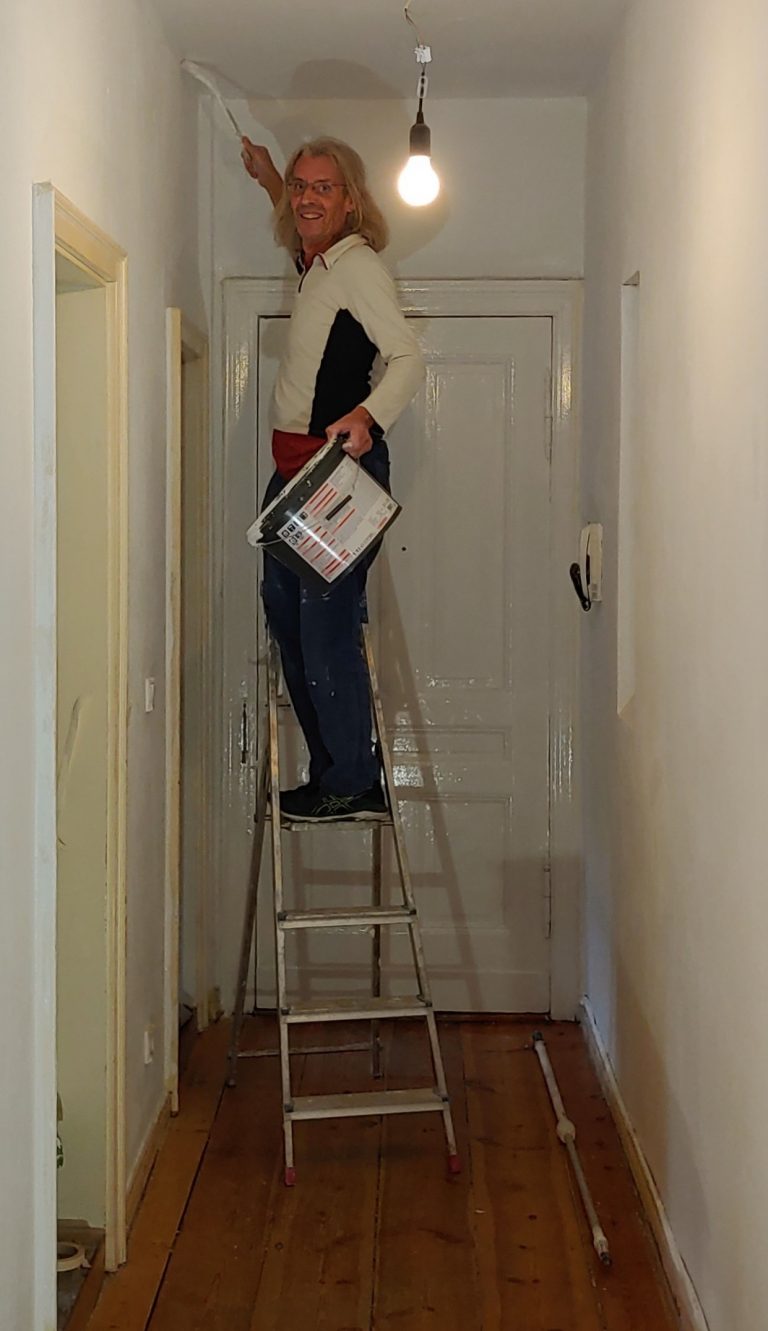
The task was clear. The place needed to be painted. The previous tenants had not made any improvements in the apartment for years and, if it were to become a cosy home, much work was required. The first task was to paint the walls and ceilings. Not quite my favourite activity, especially during the autumn week when the final warm rays of sun came flashing through the leaden clouds which had been hanging overhead for days.
As it turned out, it was the conception of the work which was much more stressful than the work itself. And half the burden was dispatched in the mere act of getting started. Once we cleared the first room, began applying masking tape around the skirting boards, window frames and light switches; when that first bucket of paint was wrenched open and the rollers wetted, a new energy of relief and excitement flooded in. We had overcome our inhibition and crossed the threshold from inaction to action.
This banal example is characteristic for so many episodes in my life. There were those times where I let the paperwork pile up chaotically over months, in dread of the inevitable necessity of preparing the – by now overdue – annual tax returns. On occasion, it took weeks for me to finally get sufficiently physically close to my desk to be able to start.
On separating the pertinent documents from the rest of the mess, and then subsequently sorting them out into various required categories spread out on the carpet, that weight began to lift from my chest and shoulders, and the excitement of having got started began to well up inside. The rest was easy.
Even more critical than in the realm of practical daily chores is the topic of (in)action when it comes to breaking out of destructive behaviours to move towards a cultivation of self care. This is a topic familiar to a wide range of personality types: the sedentary `couch potato´ who knows that physical exercise is not only warranted but would also be beneficial and probably even enjoyable, the junk food consumer who knows deep down that a better diet would bring about positive changes in body, mood and well-being, and the social media/streaming aficionado whose FOMO tendencies result paradoxically in actually missing out on the real life beyond the `semi-precious stone´ as Leonard Cohen described it in his hauntingly beautiful song about `Nancy´.
The destructiveness of this trap of procrastination reaches its pinnacle in the case of addictive behaviour, be it behavioural, substance-related, or both. It is encapsulated in that old worn-out phrase: `I’ll quit tomorrow´.
Here we see that the dis-ease of addiction has an in-built self-perpetuating component which makes it exceedingly difficult to spring the trap once we have, often inadvertently, jumped, wandered, or fallen in.
`Don’t ask: Why so much addiction?,´ says renowned psychiatrist Gabor Mate, `but rather: Why so much pain? ´
Whatever the addictive dynamic, its original purpose was as a solution to the perceived unbearable dis-ease of the human condition. And it generally worked. At once, we felt a sense of `ease and comfort´ which took the edge off our restlessness, irritability, and discontentedness.
We discover, often in our formative teenage years, a magic wand that works, and we hold on to it for dear life, often long after it has ceased to function – as it inevitably will –, even to the point where we are prepared to pay with our lives for the prerogative of doing so.
Having grown up in a very `male, white, scientific mind´ family environment, bereft of the vocabulary and syntax of emotional expression, it is no wonder that I took up residence in the mind. In fact, I became totally identified with my thinking, which was not always characterised by loving kindness to self, others, or circumstances.
`We cannot think our way into a new way of acting; we can only act our way into a new way of thinking´, is a phrase which has helped guide me from old destructive behaviours to a gentler, life-affirming way of living.
Once we believe we are our thinking, we become enslaved to the thought process that rattles on, nonstop, between the ears. When we compound the unavoidable pain of the human condition with layers of suffering, which is always optional, the result may propel us to wanting to `zone out´ of our feelings. Another option is to attempt to combat our `stinking thinking’ with even more thinking. This is tantamount to pouring oil onto a fire in the hope of putting it out.
Either way, we simply multiply our difficulties until we reach our final breath, or, if we are lucky, we are forced, through getting sick and tired of being sick and tired, to capitulate and open ourselves to new possibilities of living life. The lie of: `Either I am in control or out of control´ must be exposed as just that. A lie.
When we get this far, those extremes are revealed as illusory, and a broad gamut of options opens up in the middle ground. `Then what am I to do?´, one would rightfully ask. `The next right thing´ is the bafflingly simple answer.
Tricks can be deployed to cultivate the discernment required to recognise what `the next right thing´ might be. The daily compilation of a written list of ten things for which I am grateful is a prime example of how a sense of entitlement can be replaced by an attitude of gratitude.
Helping others is another prime example; whether it is caring for members of our family, visiting the residents in the local old people’s home, or quietly collecting trash along the riverbank, these activities take us out of the constant spinning of wheels, revolving around ourselves, our worries, and our complaints.
Of course, we cannot transmit what we haven’t got, so self-care, in the myriad of forms this can take, provides ample opportunity for action. It simply requires the decision and being held accountable for executing such decisions. This can be helped along by engaging an `accountability buddy´ (or group) where each one gently helps the other in keeping the agreements we have made with ourselves.
The imaging technology now used in the realm of neuroscience demonstrates that those areas of the brain associated with discontinued actions and belief systems wither and die, while those related to newly embraced and practiced behaviours and beliefs develop and thrive. They can be maintained and strengthened by engaging in a daily practice of mental fitness.
My ego wants to have me at the centre of the universe. That is its job, after all. It is in its nature to try to get me back there any time I have matured to becoming a part of humanity as opposed to apart from it. Its most lethal weapon is fear-based thinking, which precludes any action which would take me out of my default comfort zone. This is true even if the supposed comfort zone is killing me.
The solution is to act despite the fear. This is the true definition of fearlessness. As the saying goes: `You don’t have to be great to start, but you must start to become great.´