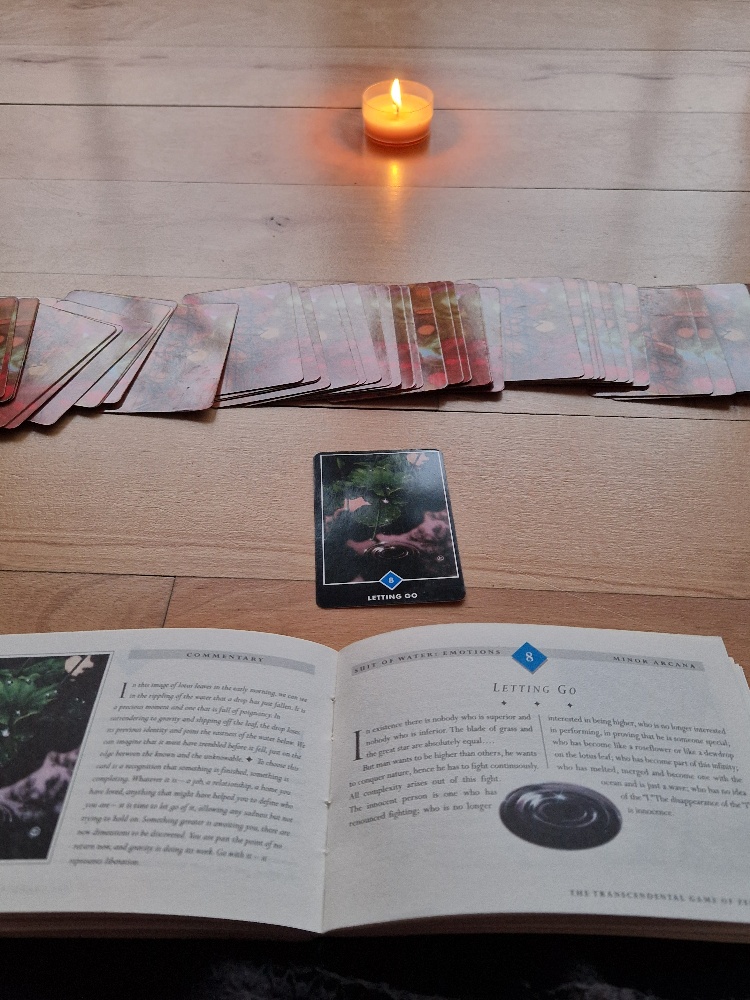
Be still and know that I am God
Be still and know that I am
Be still and know that I
Be still and know that
Be still and know
Be still and…
Be still
Be
Richard Rohr
We are here to awaken from the illusion of our separateness.
Thich Nhat Hanh
The experience of eternity right here and now is the function of life. Heaven is not the place to have the experience; here is the place to have the experience…. Eternity isn’t some later time. Eternity isn’t even a long time. Eternity has nothing to do with time. Eternity is that dimension of here and now that all thinking in temporal terms cuts off…. the experience of eternity right here and now, in all things, whether thought of as good or as evil, is the function of life.
Joseph Campbell, The Power of Myth
We need to find God, and God cannot be found in noise and restlessness. God is the friend of silence….. The fruit of silence is prayer, the fruit of prayer is faith, the fruit of faith is love, the fruit of love is service, the fruit of service is peace.
Mother Teresa
Recently, I was very pleased to receive an invitation to lead the morning meditation sessions at a five-day international conference for people living in recovery from substance and/or process addictions. In Twelve Step recovery – the latest figures suggest that there are now in the region of 300 different fellowships that deal with specific topics such as gambling, workaholism, co-dependence, food issues, screen addiction, to name just a few – meditation is suggested as an integral part of our daily practice.
The first fellowship of this type to emerge, Alcoholics Anonymous, was founded in the 1930’s, spearheaded by Bill Wilson, a New-Englander then resident in New York City. Bill, a hopeless alcoholic (in his words), had been on death’s door and had, after many failed attempts, quit drinking at the end of 1934, having had what he described as a „spiritual experience“.
He and (medical) Dr. Bob Smith first met on May 12, 1935, in Akron, Ohio, at the home of the socially engaged Henrietta Seiberling, who had arranged the encounter, after Bill put out an offer to be of help to anyone wanting to quit drinking.
It was Mother’s Day and Bob was terribly hungover. He acquiesced to his wife’s plea to meet Bill Wilson under the condition that he would give that guy fifteen minutes, at most, and then go home.
On meeting, the two alcoholics retired to a private room, talked for hours, and came to the realisation that one alcoholic helping another was key to recovery. They emerged after eight hours and immediately began carrying the message to other alcoholics. Their encounter marks not only the beginning of the AA fellowship, but the global, multifaceted Twelve Step Recovery movement that exists today.
The conference to which I had been invited was innovative, in that it was open to anybody engaged in or even interested in participating in any of the several hundred fellowships which exist today. Initiated and organised by members of Debtors Anonymous International, it was attended by people of different nationalities, ages, and backgrounds. What we all have in common is that we apply the Twelve Steps in our efforts to transcend our adverse childhood experiences, throw off the bondage of addiction, and attain a measure of Emotional Sobriety in our daily lives.
Bill Wilson became a prolific writer for the rest of his life. He had not ever drunk alcohol again when he died in January 1971. His writings are a source of deep insights into the human condition and into how story telling, community, and conscious awareness are keys to cultivating and maintaining a life characterised by purpose, service, kinship, self-care, peace of mind, and joy.
In his essays on the Steps, published in 1952, he states, referring to Step Twelve, (Having had a spiritual awakening as the result of these – previous eleven – Steps, we tried to carry this message to Alcoholics and to practice these principles in all our affairs.): „The joy of living is the theme of AA’s Twelfth Step and action is the keyword.
Here we turn outward towards our fellow alcoholics who are still in distress. Here we experience the kind of giving that asks no rewards. Here we begin to practice all Twelve Steps of the programme in our daily lives so that we and those about us may find Emotional Sobriety. When the Twelfth Step is seen in its full implications, it is really talking about the kind of love that has no price tag on it.“
He then goes on to write: „Our Twelfth Step also says that as a result of practising all the Steps, we have each found something called a spiritual awakening. To new AA’s, this often seems like a very dubious and improbable state of affairs. „What do you mean when you talk about a `spiritual awakening´?“, they ask.“
Here we take a quick tour through the Steps, telegram style. Step One is about awareness, admitting our problem, our powerlessness over the problem (as long as we remain in the energy field of the ego), and embracing the unmanageability of life.
Step Two is about belief. We believe that the problem can be solved and that the resources needed to do so (the energies of higher frequencies) are freely available to us all.
In Step Three we hand our will and our lives over to the care of these higher energies.
Steps Four through Nine are the execution of that decision: Drawing up an inventory of our lives, sharing this with others, spotting the patterns that no longer serve us, being willing to have them taken from us, explicitly requesting to be liberated from same, becoming willing to making amends to those we have harmed, and finally, making those amends as best we can. The short version of these first Nine Steps is: Trust God and clean house….!
Step Ten (We continued to take daily inventory and when we were wrong promptly admitted it.) is a compact version of Step Four through Step Nine, for daily application.
Which brings us to Step Eleven. (Sought through prayer and meditation to improve our conscious contact with God, as we understood God, asking only for knowledge of God’s will for us and the power to carry that out.)
The first part of this step touches upon what we all know from our experience of relationships. If a relationship is to thrive, we must make time to communicate, spend time, and listen to each other, without judgement and with appreciation. We wouldn’t want to ignore each other, put each other down, to interrupt each other as we exchange our thoughts and feelings. We can all see the need for regular communication if any relationship is to thrive.
It is exactly so with respect to our relationship with the higher energies, – the Great Spirit, Mother Nature, Gaia, God, however you like to label this phenomenon.
This is why the Twelve Steps encourage us to engage daily in silent prayer and meditation as part of our practice. I refer to this as my „silent hour“, usually the very first hour of the day.
It is the second part of this step that is really scary. What happens if the Will of the Universe (Thy will) does not match my will? He we need to apply the trust that has been growing since we began the journey of recovery. We are invited to trust that, whatever transpires, we will be given everything we need to carry out our calling, and be happy, joyous, and free while doing so.
Bill’s essay on Step Eleven begins thus: „Prayer and meditation are our principal means of conscious contact with God.“
Then, with his somewhat scurrilous sense of humour, he gets right to the point: „AA’s are active folk, …. so, it isn’t surprising that we often tend to slight serious meditation and prayer as something not really necessary. To be sure, we feel it is something that might help us to meet an occasional emergency, but at first many of us are apt to regard it as somewhat mysterious skill of clergymen, from which we may hope to get a secondhand benefit.“
I love it! „Active folk“!
Long before the introduction of concepts such as ADHD, Complex PTSD, Hyperactivity , or Autistic Spectrum Disorders, Bill spots the fact that we addicts have a tendency towards restlessness which makes it difficult to calm down and sit still. As we say: „If you spot it, you’ve got it.“ Bill, like me, was no exception!
As Mother Teresa notes, (Conscious contact with) God cannot be found in noise and restlessness. God is the friend of silence….. Noise and restlessness engender fear. Silence is the portal to connecting to the higher energies, the energies of love.
Just one note on prayer. Over the years I have discerned only two types of true prayer: The first is a state of gratitude and wonder. The second, a heartfelt request for the reawakening of our conscious awareness of the higher frequencies whenever we have cut ourselves off.
„If we wake up one morning and find there is a chasm between us and God,“ wrote Meister Eckhart over eight hundred years ago, „we can be sure that we are the ones who have moved away.“ That is good news indeed, because just as we have the capacity to shut ourselves off from the higher frequencies, we have the agency and power to reconnect.
I like the story about Mother Teresa being once asked by a young journalist to describe her daily prayer and meditation practice.
„I simply sit in silence and pray“, she answered with clarity.
„What do you say?“, asked the journalist, intrigued.
„Oh, I say nothing. I simply listen to God.“ she replied.
„And what does God say? “ asked the journalist, sniffing a sensation…
„God doesn’t say anything, either,“ responded the old nun with a smile. „God simply listens also.“
„If you have never had the experience, nobody can explain it to you,“ she then finished, bowed courteously, and went on her way.
Towards the end of his essay on Step Eleven, Bill goes on to state: „Perhaps one of the greatest rewards of meditation and prayer is the sense of belonging that comes to us. We no longer live in a completely hostile world. We are no longer lost and frightened and purposeless.
„The moments we catch even a glimpse of God’s will, the moment we begin to see truth, justice, and love as the real and eternal things in life, we are no longer deeply disturbed by all the seeming evidence to the contrary that surrounds us in purely human affairs. We know that God lovingly watches over us. We know that when we turn to God, all will be well with us, here and hereafter.“
Now we can formulate the complete short description of the programme, including Steps Ten, Eleven, and Twelve: „Trust God, clean house, help others!“
Joseph Campbell makes an important point when he says that this glimpse of the Divine is the experience of eternity. We often naively believe that eternity is just a whole lotta time. This is misleading. Eternity is an experience beyond space and time.
Eternity can be accessed exclusively through the conscious awareness of the present moment. Here is where the meditation comes in. Most of us are caught up in a relentless stream of thoughts which distract us from awareness of the present moment. Regrets or resentments related to the past or anxiety and fears regarding the future keep us fully engaged in this distraction. We call this „stinking thinking“.
Like the snow globe that is shaken every thirty seconds, our mind never comes to rest. By engaging in a regular, continuous meditation practice, the mind becomes increasingly clear of clutter and interference. We begin to cultivate that gap between stimulus and response to which Viktor Frankl refers: „Between stimulus and response there is a space. In that space is our power to choose our response. In our response lies our growth and our freedom.“
Experience has taught me not to begin a guided meditation session with lots of content. It is emptiness that characterises meditation. Se we began each day with a short body awareness exercise (breath, weight of our seat in the chair, shifting the weight of our feet from right to left and back a few times, etc.) before entering into fifteen minutes of silence.
„Don’t forget to put a smile on your lips as you begin,“ suggests Thich Nhat Hanh.
After our short meditation we shared our experience, exchanged stories about aspects of meditation such as the use of mantras, and closed out by together reciting a reflection or simple prayer.
One question came up a few times: „How do we do a really good meditation?“ My answer is always the same. Any meditation done with the intention of doing a good meditation, is – per definition – not a meditation. Instead, we can sit like Mother Theresa, and follow wherever the experience takes us, not blotting out the thoughts that continuously arise, and not clinging onto them as they do.
Whenever your mind becomes scattered, use your breath as the means to refocus and gently take hold of your mind again. Then continue as before. Repeat as long as you are sitting.