An individual’s torments only have meaning within his or her personal experience. Faced with the collective we are as naked and helpless as the day we were born. Our individual development depends on realizing that others cannot understand our experience. Sometimes the obstacles we meet tempt us to place our destiny in the hands of another. But we cannot live by proxy, we must take everything on our own shoulders. Then we know we are alone. We must allow this sensation to fill our being and live like abandoned children because only thus is our life in our own hands. From time to time a mirage will surface of some way of life that will free us from the feeling of abandonment; but a mirage is exactly what it will remain.
We can of course live solely within the collective, with the illusion of speaking a common language and of not being alone, but this deception can cost our lives. If we act according to the general rule, we are following a code that is not our own. Everyone must find his or her own tune, accepting the resulting abandonment by those who continue singing in concert.
Aldo Carotenuto
The soul that sees beauty may sometimes walk alone.
Henry David Thoreau
But many of us seek community solely to escape the fear of being alone. Knowing how to be solitary is central to the art of loving. When we can be alone, we can be with others without using them as a means of escape.
Bell Hooks
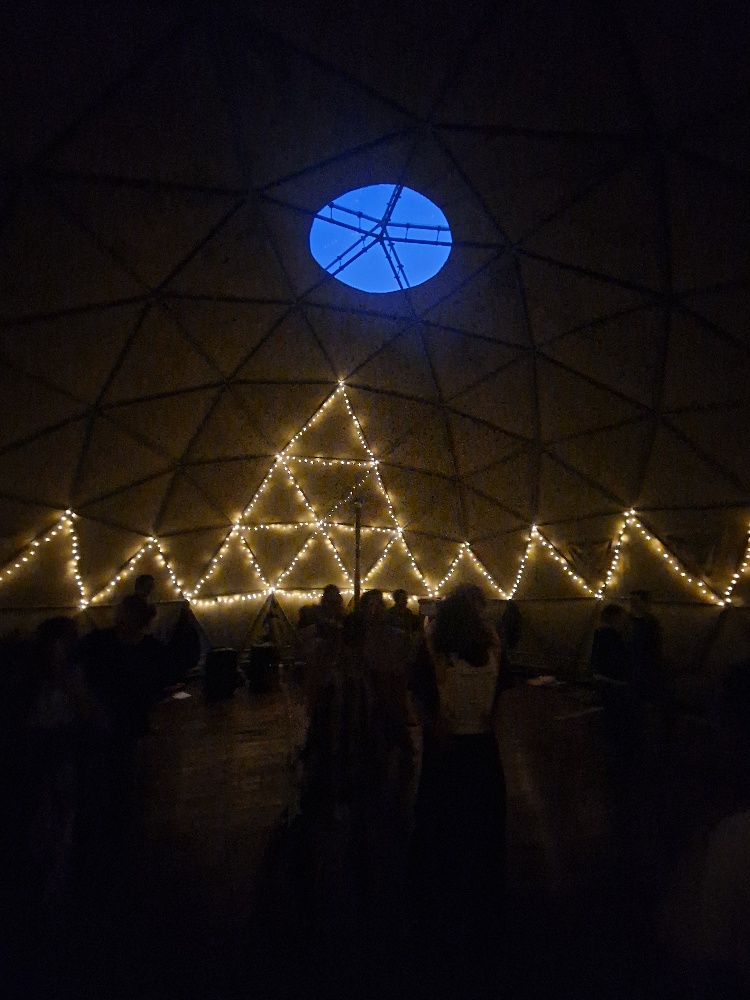
My participation at a Winter Solstice Tribal Gathering this past weekend brought the words of Aldo Carotenuto to mind. To what degree can we fulfil our yearning, our deepest longing, to belong? What role can community play in the blossoming of our unique blossoming from stardust into a once-in-a-cosmos, vibrant flower of vitality? To what degree can we find solace and comfort in the arms of another, and are we truly abandoned, as Carotenuto argues? These are wonderful questions to explore as we tarry in the dark days of the Winter Solstice here in the northern hemisphere.
In much of my work, both my own inner work and working with others, the topic of abandonment comes up again and again. It is one of the most common childhood wounds of the people among whom I move.
It is true, that of all the mammals treading Mother Earth, the human is, by far, the most helpless at birth. The horse gets up immediately after hitting the ground and begins to run around. The apes learn to feed themselves relatively quickly. It is only the human who requires the best part of two decades before she can stand truly independently in life and exercise the totality of her agency.
This requires of the parents and caregivers, an immense dedication to selfless service. When the capacity exists and it is freely given, the child will blossom in the fertile ground of joy, harmony, and unconditional love.
In reality, most adult caregivers, even with the best intentions, will fall short of the ideal. Some of us may even fail miserably, due to the fact that we never received this quality of care from our respective caregivers. Clearly, we cannot transmit what we haven’t got.
Even worse conditions can arise when the wounded adults see projection as their only means of connecting. The abused become the abuser. An inability to identify and grieve the losses of our early lives leads to the immense pent-up energies coming out sideways, almost always with destructive consequences.
The generational chain is ancient, powerful, and has embedded itself in every cell of our bodies. Thankfully, we are now developing a consciousness and associated healing modalities which is helping us in breaking this chain, for the good of humanity as a whole. For more on this, the Twelve Step Programme of ACA (Adult Children of Alcoholics – designed for anybody wishing to recover from growing up in a dysfunctional family) is highly recommended.
The question of abandonment comes up for many of us as we journey towards the recovery of the True Self we abandoned as children in order to secure the minimum of attention and care we needed to survive those formative years.
The good news is that no matter how lost we have become, there is always the hope and possibility of transcending childhood wounds and progressing into a phase lovingly referred to as Post Traumatic Growth (PTG). This is the message of the celestial spheres as we go through the Twelfthtide.
For me, this fourteen-day period begins in the days preceding the solstice and lasts through to the first days of the new calendar year.
The irony of transcending the original wound of abandonment is that it is achieved in our learning to consciously let go of something to which we have been clinging – the False Self, the „persona“ (Latin: mask) – and voluntarily abandoning ourselves to the higher energies of what is variously referred to as the Great Spirit, Gaia, the Universe, or, in the classical approach, God.
This brings me to the relationship between abandonment and devotion. As a person who grew up in the Irish Catholic culture of the 1960’s and 70’s, devotion is no stranger to me. Even then, in my boyhood innocence, it struck me that most folks were going through the motions but that the true Spirit was missing.
In hindsight, this is no surprise since organised religions have been screwing people over for aeons. The Catholic church, for example, quickly lost its way, becoming more interested in money, property, and prestige and thus allowing itself to be diverted from its primary purpose, which should be spreading, by example, the message of unconditional love as preached and modelled by Christ, whose birthday we celebrate this week.
As my lens widened with the years, my initial assumption was that this probably applied to all organised religion until, that is, I experienced worship as practised together by hundreds of thousands of devotees of one of the leading Gurus of the Sikh Sant Mat tradition.
Sant Rajinder Singh Ji Maharaj is a „Godman“ in the lineage of Guru Nanak (15 April 1469 – 22 September 1539), a respected and revered spiritual leader of the Sikhs five hundred years ago. Guru Nanak is recognised as the founder of Sikhism, a spiritual path that includes faith and meditation on the name of the one creator; unity of all humankind; engaging in selfless service, striving for social justice for the benefit and prosperity of all, and honest conduct and livelihood while living a householder’s life.
Today, his successor, Rajinder Singh Ji Maharaj, is sought out by millions of people, both in India and all over the world, as a spiritual guide.
My initial encounter with him in Europe in 2012 was quickly followed by a visit to his ashram in New Delhi, where I witnessed gatherings of several hundred thousand people who had come together for an entire week, to seek out the gaze of the master („darshan“).
In truth I was initially a witness but quickly became a party to an energy field of devotion which cannot be expressed in words. To this day, I am grateful for this and further similar experiences. Devotion in this sense is best translated in German as „Hingabe“, i.e., the giving (away) of one’s self. While organised religion in the Occident is bereft of such energies, in my experience, they are alive and well and very much part of the spiritual culture in the Orient.
The trap here is that this experience can become a mirage of a way of life that will free us from the feeling of abandonment; but a mirage is exactly what it will remain. As any Guru worth her or his salt will underscore: „It is the responsibility of the Guru to liberate the Sadhu („seeker“), even from the Guru!“
What, therefore, can the role of community be in our recognition of our fundamental aloneness (All One Ness) in this incarnation? We can learn from and with each other. The best way to internalise any practice is to teach it, to give away what we have been given in Grace, as a free divine gift.
Also, the „difficult“ people we encounter can become our „Jedi Masters“ in helping us to confront our own demons and Saboteurs, and ultimately, to transcend them.
The draw of a community such as the Christaland Community I encountered this Solstice in the south of Portugal, is great. What is especially attractive is that fact that the members, young and old, are people who have adopted a life clean and sober, who live in the spirit of tolerance and compassion, and are equally passionate about Mother Nature, movement, and dance as yours truly.
The maxim, therefore, along the lines of the teaching of the Great Master, is to „be in the community but not of the community.“
Since, over the course of decades of inner work, I have embraced the experience of my own solitude, it is much easier to overcome the result of my initial experiences of abandonment, namely isolation – fortified by self-isolation. As pointed out above by Bell Hooks, knowing how to be solitary is central to the art of loving, and indeed of living. When we can be alone, we can be with others without using them as a means of escape.
When we can be alone, we can even better be „all one“ with the entirety of Creation. In this energy, we can face whatever crosses our path, in the spirit of devotion, primordial trust, and love.