
To let go is to release the images and emotions, the grudges and fears, the clingings and disappointments of the past that bind our spirit.
Jack Kornfield
We must be willing to let go of the life we’ve planned, so as to have the life that is waiting for us.
Joseph Campbell
You can only lose what you cling to.
Buddha
Suffering is not holding you. You are holding suffering. When you become good at the art of letting sufferings go, then you’ll come to realize how unnecessary it was for you to drag those burdens around with you. You’ll see that no one else other than you was responsible. The truth is that existence wants your life to become a festival.
Osho
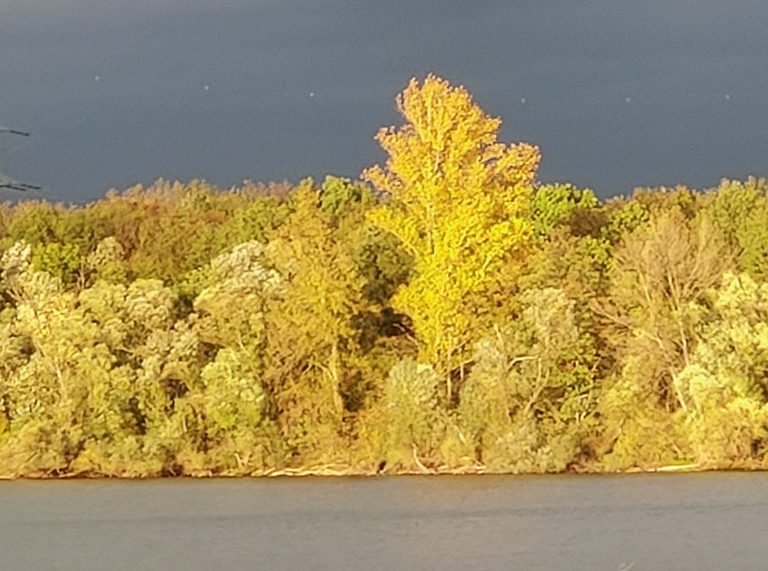
Autumn has arrived with a bang. This week commenced with the first cold nights under the full moon, with the temperatures falling to single figures. The effect was immediately visible all about, in the colouring of the leaves.
Then came the first Atlantic storm of the season. Its advent prompted me to tidy up my veranda, putting away anything that could be carried off by the impending gusts, and securing pots of shrubs and gardening materials. Then I could receive the storm with open arms. At first the winds brought almost humid temperatures, followed by copious quantities of rain, after which a cold front followed. Now, as I write, the wind has died down, the paths are blanketed in layers of leaves, the skeletal forms of the great trees on the river bank semi-visible, and magnificent colours abound. It is the time of letting go.
How I used to struggle at this time of year! October inevitably ushered in a downward spiral of depression that was sure to last through the end of the calendar year. I saw my self as the victim of this dynamic. The more I pitied my self for this, the further I plummeted. It never occurred to me that I might be holding the joystick; that it was through my own actions and thoughts that I headed on this downward trajectory of despair. Those insights were to come later.
Of course I had more that enough reason to justify my suffering. Many years ago, when I was in my mid-teens, my father left this incarnation on November 10th, a cold, grey, rainy day – if my memory serves me correctly. Then, five years later, on October 25th, I had the privilege of seeing my mother through her final hours, an occurrence of great sadness nonetheless. Both had been taken in their early fifties; I was still no more than a boy.
Presumably, unbeknownst to my self, I took this stroke of fate personally, using the experience to generate a resentment to which I clung for a very long time. If you had asked me at that time, the response would have been that all was fine. Resentments are like that; cunning, baffling, and powerful, like `drinking poison and hoping someone else will die from it´.
It was not only resentments which needed to be let go of, in order to leave the depression and the negation of life behind. There was the `woulda, coulda, shoulda´ habit of rummaging through all the wounds of the past, or indeed anything that had not turned out the way I would have liked. Being at war with the past, when seen from a healthy distance, is obviously not a constructive activity. However, once caught up in the maelstrom, it becomes increasingly difficult to recognise what dynamic is at play and, equally important, my role in establishing and perpetuating it.
Then there were the fears. I was a sensitive, often fearful child. This may have been influenced by my poor eyesight, a fact which was discovered only in my early twenties when going through the process of acquiring my driving licence. Spectacles were prescribed. When put in place for the first time, I was flabbergasted that the individual leaves of an oak tree were visible, as were the single elements in a redbrick wall.
But it was not only that. I was terrified of the prospect of physical violence. This fear, coupled with a degree of clumsiness, made for a bad standing among my peers, especially in the domain of sports and athletics. Only those who have experienced it know how it feels to be the last or second-last boy, of twenty or more, standing at the fence when the two appointed `captains´ (the most fearless and talented athletes) were closing out the process of picking their teams for an impromptu game of ball. That, too, left wounds, to which I clung for years to come.
Other fears, too many to compile in full, tormented me. That of losing what I had and that of not getting what I considered my due, ranked high on my list. Add to these the fears of rejection, failure, ridicule, and abandonment, and a toxic cocktail is readily at hand. In the years directly preceding my mid-life crisis, all this had morphed into the fear of fear, the worst, most debilitating fear of all.
Then there were the false beliefs. These included ideas such as: `There is no place for me´, `At bottom, I am a bad person´, and `Whatever my achievements, they will never be good enough´. It is now clear to me how these beliefs evolved. They are, however, counter-productive to my efforts to move from being `apart from´ to `a part of´ the greater whole. In order to progress through depression to the healing beyond, they had to go.
The false beliefs come in a double pack with old behavioural patterns. One such pattern I developed as a child was to `disappear into the crowd´. I had a knack of disappearing emotionally in the surrounding chaos. This gave me a sense of relief and calm. I can see how it might have been useful, even necessary, as a child; it strikes me as a pattern which today would stand in the way of self-knowledge and emotional intelligence. As with the beliefs, the patterns needed to be inventoried and, where no longer useful, relinquished. I learned that the way to do this is to practice behaving in the opposite fashion until a healthy middle point had been reached. It is a journey, not merely of feeling better, but rather of getting better at feeling.
Finally, on recognising that the illusion that `I had to do everything my self´ had been contributing to my malady, this too had to be jettisoned. This meant asking for help, not something that comes easily to me. I surrendered to the fact that I was in a trap which, though my own devices, I could not spring, and reached out for help. This I found in others who, through their own experience, knew my dilemma and had not only found a solution, but were, as an integral part of this solution, eager and ready to help the next folks embarking on the road to recovery.
The journey continues to this day. Having learned to let go of the insistence on living life on my terms and instead bowing to, and embracing the terms of the Universe, I can now participate in the autumnal dance, one among equals, with an appreciation for the transience of existence and a love of the present moment. The deep beauty of autumn has never been as palpable as in this past week.



Eine Antwort
This has impacted me. You told my feelings to a tee. Thank you for sharing. Plenty of food for thought.